Medical Malpractice Lawyer in Michigan
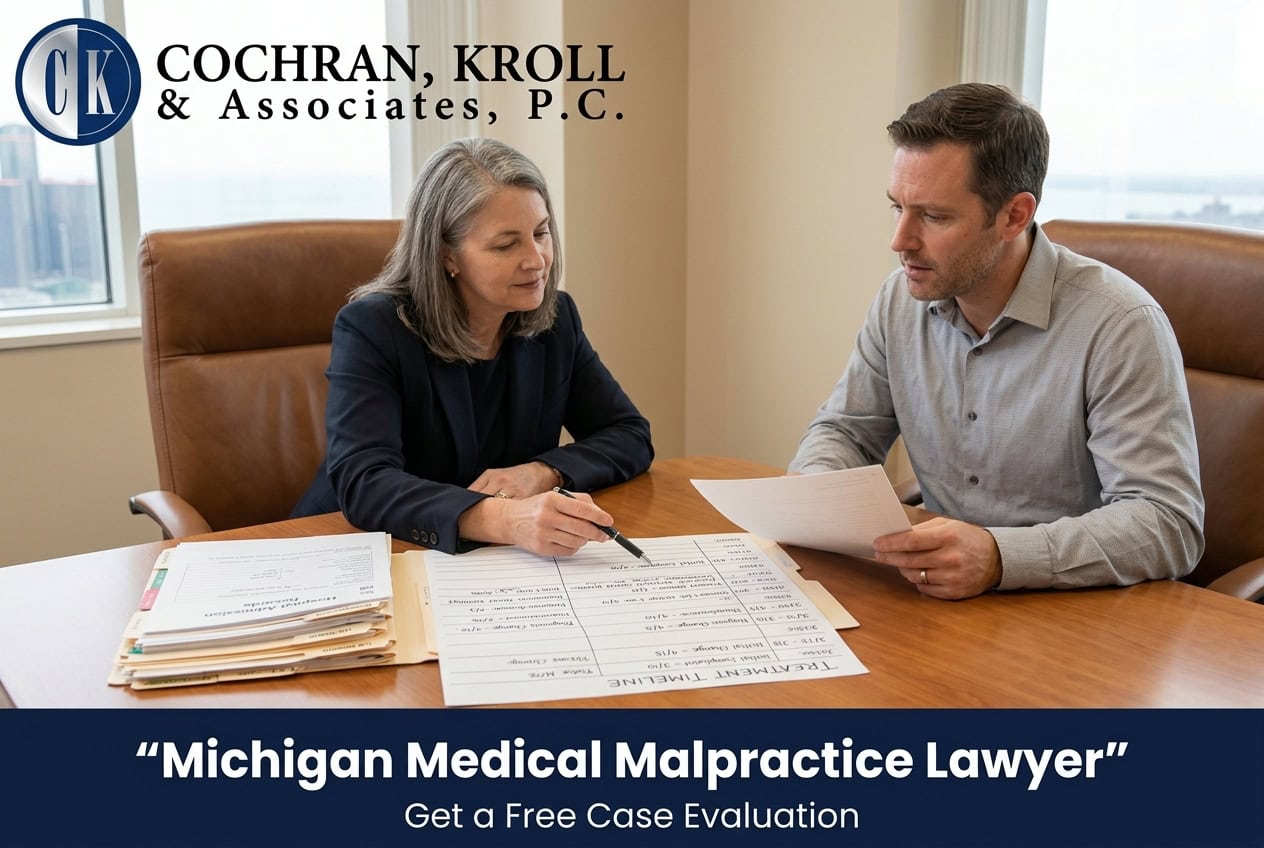
A medical malpractice lawyer in Michigan reviews medical records and checks the care that was given. Then, they see if the care fell below the proper standard and if the mistake likely caused serious harm. However, the job is not only about filing a lawsuit. It also means checking the facts, timing, and medical proof to see if the case meets Michigan’s strict rules.
Key Takeaways
- Not every bad medical result is malpractice.
- A strong claim usually turns on proof, causation, and measurable harm.
- Timing matters because Michigan malpractice claims follow strict filing rules.
- A case review often starts with records, a timeline, and expert screening.
- Cochran, Kroll & Associates, P.C. offers free case evaluations and contingency-fee representation.
Get a Free Case Evaluation
Need help now? Call 1-866-MICH-LAW any time, or start a free case evaluation form.
When a serious medical result follows treatment, families usually want two things: answers and a clear next step. Cochran, Kroll & Associates, P.C. helps people across Michigan understand whether the facts may support a claim and what the review process usually involves.
What Does a Medical Malpractice Lawyer Do?
A malpractice lawyer usually gathers records, builds the timeline, looks at whether the standard of care may have been missed, and checks whether that mistake likely caused real harm.
In practical terms, that often means:
- listening to what happened
- collecting the key records
- screening the case with qualified medical experts
- handling the next legal step if the facts support moving forward
Important: A poor medical outcome, by itself, does not automatically mean malpractice.
What is Medical Malpractice or Medical Negligence?
Medical malpractice is when a doctor or healthcare provider causes harm to a patient by failing to do their job properly. It happens when the care given falls below the accepted medical standard, resulting in injury, illness, or death of the patient.
Medical care is not perfect. Complications can happen even when providers act carefully. A possible claim usually starts with a different question: did a provider act below the accepted standard of care, and did that mistake likely change the result?
What Does the Standard of Medical Care Mean?
In simple words, the standard of care is the level of care a reasonably careful provider would use in similar circumstances.
That does not mean every provider must make every patient well. It does mean patients should receive care that is reasonably careful, timely, and appropriate for the situation.
What Must a Medical Malpractice Claim Prove?
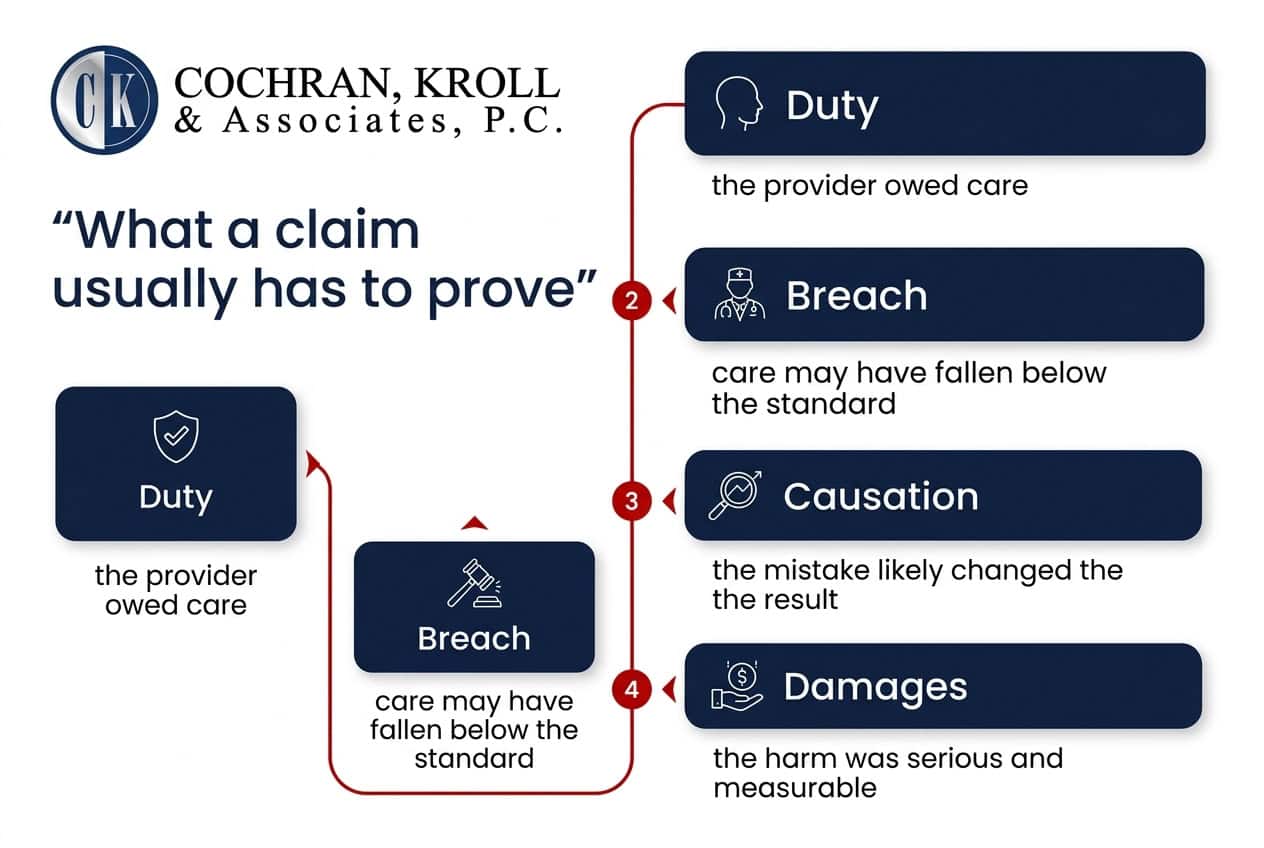
A strong malpractice case usually has to show four connected points:
| Element |
What it means |
What may help show it |
| Duty |
A provider or facility owed care to the patient |
Treatment records, admission records, and provider relationships |
| Breach |
The care may have fallen below the accepted standard |
Expert review, chart details, missed orders, and delayed response |
| Causation |
The mistake likely changed the outcome |
Timeline, expert opinion, progression of harm |
| Damages |
The patient suffered measurable harm |
Bills, lost income, future care needs, pain, and life impact |
That last point matters. A technical mistake with no meaningful harm may not support the same kind of claim as a preventable error that caused major injury, disability, or death.
How Do I Know If I Have a Medical Malpractice Case?
| When you have a case |
When it is not the case |
| You believe a doctor, nurse, hospital, or facility made a preventable mistake |
You only want a guaranteed outcome or settlement estimate |
| The harm was serious, lasting, or life-changing |
You are looking for exact legal advice without a case review |
| You have records, a rough timeline, or clear questions about what went wrong |
The issue was a disappointing result with no sign of negligence |
| You want to understand the next step before deciding what to do |
The claim is outside Michigan and not tied to the firm’s supported service areas |
Common medical practice issues that often deserve a closer look include:
- delayed diagnosis
- surgical error
- birth injury
- medication mistakes
- failure to monitor
- emergency room breakdowns
- Serious hospital negligence
How Does a Case Review Process Usually Work?
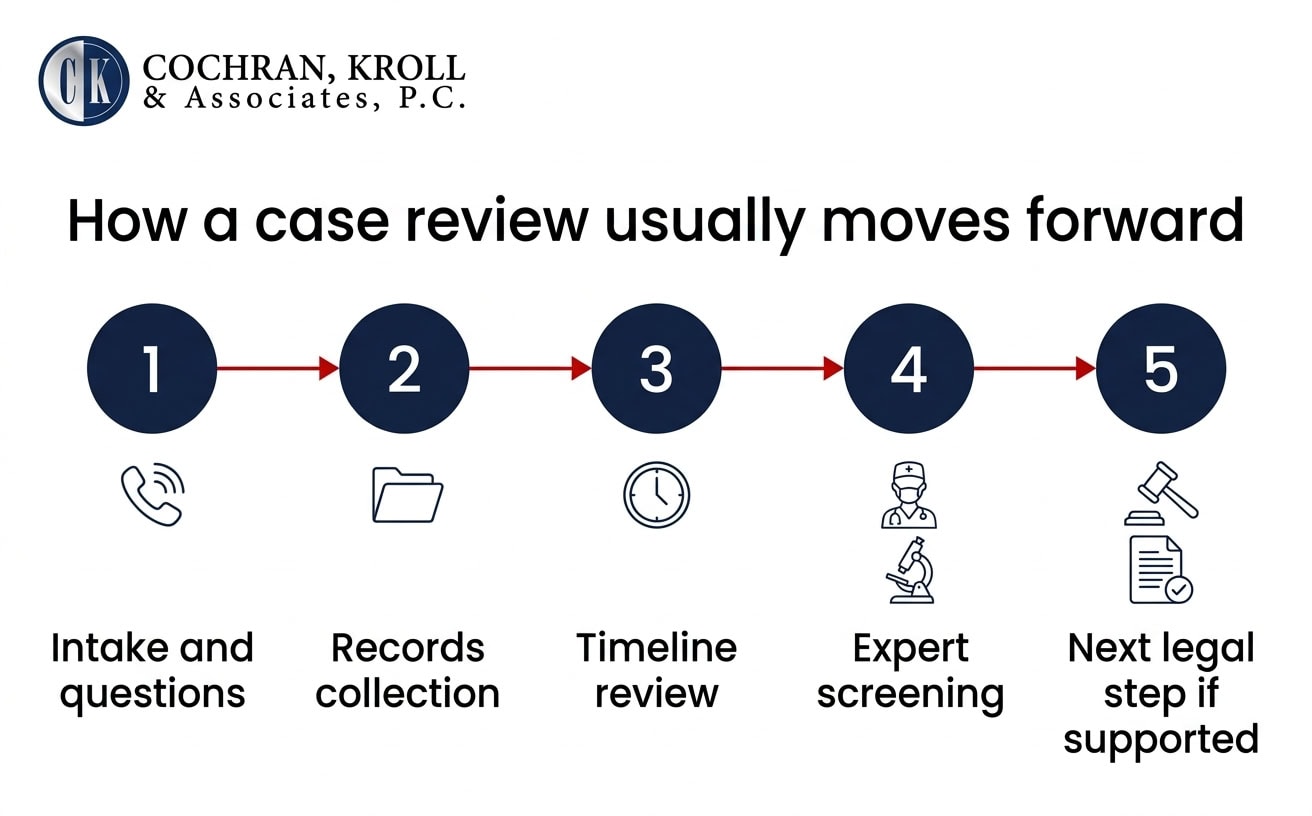
Most families do not start with a polished file. They start with a story, questions, and a feeling that something went wrong. That is normal.
A review often moves forward like this:
- Listen to what happened.
The firm learns the basic facts, dates, providers involved, and the harm that followed.
- Collect the key records.
That may include hospital charts, physician notes, imaging, lab results, discharge papers, and follow-up care records.
- Build the timeline.
A timeline helps show what happened first, what should have happened next, and where the breakdown may have occurred.
- Screen the case with qualified experts.
An expert review helps answer whether the care may have fallen below the standard and whether that likely caused the injury.
- Evaluate the next legal step.
If the facts support moving forward, the case can move into the next phase. If not, you should still get a clearer view of where things stand.
Not every matter proceeds. A good review helps separate understandable suspicion from a claim with evidence behind it.
What Are the Deadlines and Steps to Make a Claim for Medical Malpractice in Michigan?
Michigan malpractice claims can involve strict timing rules and pre-suit requirements. That is one reason families should not wait too long to ask questions.
At a high level, these cases may include: A review of when the care happened
- A review of when the harm became clear
- A required pre-suit notice step in some cases
- An affidavit from a qualified expert when a case is filed
Two terms often come up:
- Notice of Intent: a formal pre-suit notice that can be required before filing a malpractice case.
- Affidavit of Merit: a document from a qualified medical expert that supports the claim when a case is filed.
The details can change based on the facts, the providers involved, and the timing. That is why a case review should happen early, even if you are still gathering records.
What Types of Medical Negligence Cases We Help You With?
Diagnostic errors
These matters may involve a missed diagnosis, delayed diagnosis, or a failure to order or follow up on needed testing.
Examples can include:
- stroke
- heart attack
- cancer
- serious infection
- other conditions that worsened because treatment was delayed
Surgical and anesthesia errors
These cases can involve mistakes before, during, or after surgery.
Examples may include:
- wrong-site or avoidable surgical mistakes
- retained items
- nerve or organ injury
- anesthesia problems
- poor monitoring during or after the procedure
Emergency-room situations can overlap with these issues, especially when triage or fast decision-making breaks down. See the firm’s page on ER malpractice claims for a related example.
Birth injury and OB/GYN cases
Some of the most serious claims involve pregnancy, labor, delivery, or newborn care.
These cases may involve:
Hospital, nursing, and medication errors
Hospitals and facilities can be at issue when harm results from system failures or bedside mistakes.
That may include:
- failure to monitor
- infection or sepsis breakdowns
- falls
- communication failures
- wrong drug or wrong dose
- charting or handoff errors
The firm also handles related serious injury matters, vehicle injury cases, and workplace accident claims when negligence causes major harm.
What Compensation Can a Medical Malpractice Claim Include?
A claim may involve both economic and non-economic losses.
Economic losses can include:
- past medical bills
- future treatment costs
- rehabilitation needs
- lost income
- reduced earning ability
Non-economic losses can include:
- pain and suffering
- loss of normal life
- emotional distress
- loss of enjoyment of life
Case value is rarely about one number or a simple average. It often depends on:
- How severe the injury is
- Whether the harm is permanent
- What future care may be needed
- How strong the proof is
- How clearly the timeline supports causation
Michigan rules can affect how some damages are handled. Those issues should be reviewed on a case-by-case basis instead of being guessed from a website.
What Affects a Medical Malpractice Case Cost?
Cochran, Kroll & Associates, P.C. states that its work is handled on a contingency fee basis. In plain terms, that means legal fees are tied to recovery rather than an upfront hourly bill.
The cost and complexity of a case can still be affected by things like:
- How many providers or facilities are involved
- How many records must be reviewed
- Whether multiple experts may be needed
- Whether the harm involves long-term future care
- Whether the case resolves early or requires litigation
The most helpful first step is not trying to price the whole case by yourself. It is getting a clear review of the facts.
Why Do People Choose Cochran, Kroll & Associates, P.C.?
Several visible trust points support this page:
- Free, no-obligation consultation
- No fees until recovery
- Michigan statewide service
- Medical record support that includes a resident registered nurse
- Decades of proven experience
- Recognition for named attorneys
- Trial-lawyer association memberships
- Media appearances as legal experts
If you want to review the firm’s public proof pages, start with its verdicts and settlements and client reviews.
The goal of a consultation is not to pressure you. It is to understand what happened, explain whether the facts appear worth deeper review, and let you know what the next step may look like.
Does the Firm Help People Across Michigan?
Yes. The firm’s brand information supports statewide Michigan service.
That statewide footprint matters because malpractice questions do not only arise in one city or one hospital system. People in Metro Detroit, Flint, and other parts of Michigan may all need the same thing at the start: a careful review of records, timing, and harm.
What To do Next If You Have a Case?
Start with the practical steps that protect your position:
- Get the medical care you need now.
- Write down the timeline while the details are still fresh.
- Save discharge papers, portal messages, bills, and follow-up instructions.
- Keep the names of providers and facilities in one place.
- Do not assume the hospital will explain everything clearly on its own.
- Bring your questions to a lawyer before timing issues become harder to manage.
If you want more background before reaching out, the firm also has a page for common legal questions.
Contact Our Medical Malpractice Lawyer in Michigan
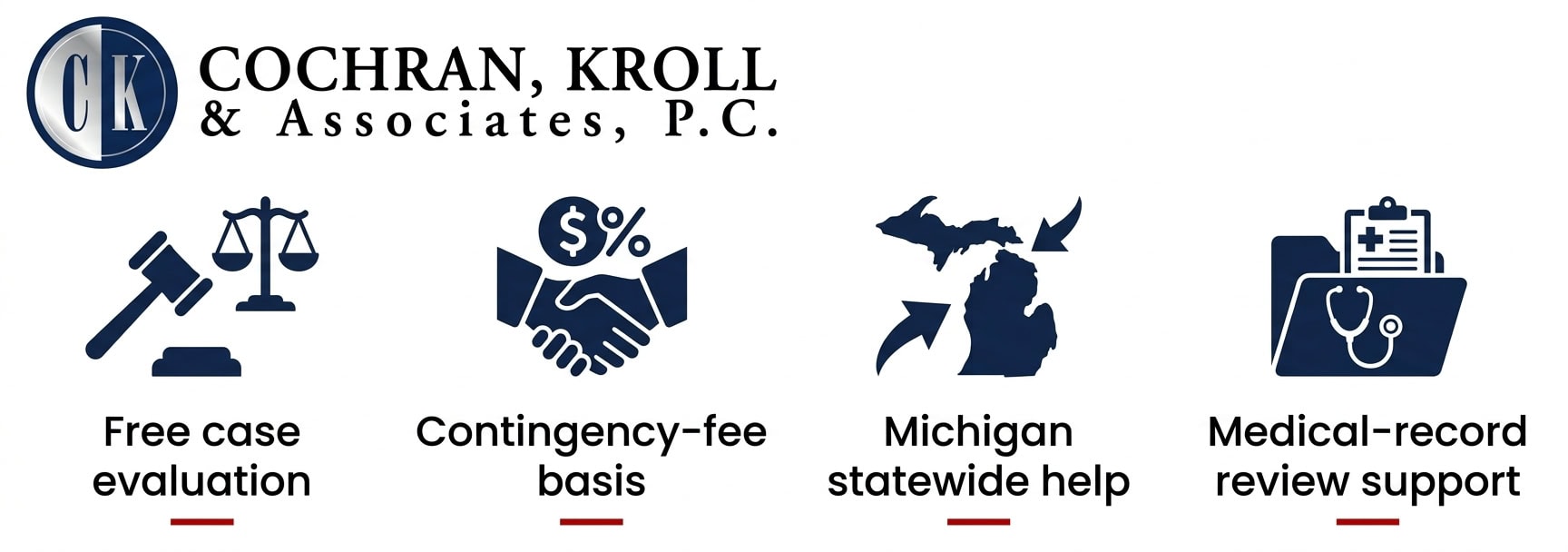
If you suspect a medical mistake caused serious harm, a Michigan medical malpractice lawyer can review records, timelines, and expert opinions to determine whether negligence may have occurred. An early legal review helps clarify your options and the next steps for pursuing a claim.
Contact us at Cochran, Kroll & Associates, P.C. for a free consultation. We’ll review your case, explain your options, and map out the strongest path forward. Remember, we don’t get paid unless you win.
Call us at 1-866-MICH-LAW anytime, 24/7, to schedule a free case evaluation.
Frequently asked questions
What is considered medical malpractice in Michigan?
In general, it means a healthcare provider may have fallen below the accepted standard of care and that mistake likely caused measurable harm. A bad outcome alone is not enough.
How do I know if I may have a case?
You usually need more than suspicion. A useful review often starts with records, the timeline, and whether the outcome appears tied to a preventable mistake.
What is a Notice of Intent, and why does it matter?
A Notice of Intent is a pre-suit step that can be required in malpractice cases. It matters because filing requirements and timing can affect whether a case can move forward.
What is an Affidavit of Merit?
It is a document from a qualified medical expert that supports the claim when a malpractice case is filed. It helps show that the case has expert-backed support.
How long do I have to act?
Do not wait to find out. Michigan malpractice timing can be strict and fact-specific, so the safest move is to get your situation reviewed as early as possible.
Can I bring a claim against a hospital, a doctor, or both?
Potentially, yes. That depends on who provided the care, who employed them, what went wrong, and how the harm occurred.
What compensation can a claim include?
It may include medical costs, lost income, future care needs, and non-economic losses such as pain and suffering, depending on the facts and the law.
Do all bad medical outcomes count as malpractice?
No. Some complications happen even when providers act appropriately. The key question is whether the care likely fell below the standard and caused avoidable harm.
What does a free case evaluation include?
Usually, it includes a conversation about what happened, the providers involved, the timeline, the harm that followed, and whether the matter appears to need deeper review.
How are fees handled?
The firm states that it works on a contingency-fee basis. That means legal fees are tied to recovery rather than an upfront hourly charge.